Feb 7, 2018 | Announcements, Shows & Conventions
(Long Beach, California) February 7, 2018 — Among the numismatic treasures that will be featured in the upcoming inaugural exhibit of rarities from the privately owned Tyrant Collection (www.TheTyrantCollection.com) will be the first public displays in the United States of some of England’s most important Anglo-Saxon era coins.
Veteran professional numismatist and English coinage specialist Bruce Lorich, on behalf of the Tyrant Collection’s anonymous owner, has cataloged the more than 500 “Tyrants of the Thames” exhibit coins to be displayed at the Long Beach Coin, Currency, Stamp & Sports Collectible Expo (www.LongBeachExpo.com) in Long Beach, California, February 22-24, 2018. This is the second in a series of four articles by him about the historical significance of some of the coins in that unprecedented exhibition.
The Importance of England’s Anglo-Saxon Coinage
Rome’s invasion of the Britons’ island in the first century BC clearly influenced England’s early money. Mixing in use with the coins of the earliest known inhabitants of the island, the Celts, the Roman money was a blend of coins imported from Rome and copies made by local die-cutters. Some were silver. A few were gold. Most were copper. They were slowly absorbed into the circulating money in various areas of the island.
Early England consisted of regions even then called kingdoms, but these were small, essentially tribal enclaves. Largely to protect themselves from these warlord kings, the Romans put up forbidding stone and wood forts. To say the least, early Britain was a hostile place. The Romans eventually tired of trying to dominate the native inhabitants. By the early 5th century, Rome began to pull out of the island, and at the same time tribal kings began to expand their territories.
The island’s indigenous people were invaded again and again over centuries by tribal warriors whose origins were such northwestern European places as Jutland (in today’s Denmark) and ancient Saxony (Germanic tribes living along the North Sea). Gauls came from the northern coast of today’s France. Angles, Saxons and Jutes began to emigrate to Briton in the 5th century. Their bloodlines merged and they began to be called Anglo-Saxons in the 8th century. During these centuries Norse invaders also came many times to the island, mixing their Viking genes with those of earlier invaders and of ancient native Britons.
In the 7th century the scattered kingdoms began issuing their own coins, mostly small pieces, often borrowing Roman designs, but they displayed legends in their own Runic alphabet. They also featured Christian symbols, mostly crosses of varying styles. Over time, the Roman coins disappeared from circulation and were steadily replaced by these little silver coins (which had sizable copper content) called “sceats.” These were all of local artistry and local issue. They appeared independent of each other in the various kingdoms of the island.
The late 7th and early 8th centuries in England were the era of the Saxon sceats, and the Tyrant Collection contains a representative selection of all the kingly issues, from Aethelred, King of Mercia, circa 674-704 AD, to Osberht, King of Northumbria, circa 848-867 AD. Dozens of types exist, many anonymous, lacking any king’s name. After a little more than a century as the principal money of the island, these small coins featuring “fantastic animals” and sometimes abbreviated names of early kings and archbishops were gradually replaced by a complicated series of larger coins of better silver that depicted chieftains and their titles scattered among the island’s kingdoms.
Some of the early English coins, however, were made from locally mined ore containing gold blended with silver and other trace metals. The most impressive of these are called “thrysmas” by today’s collectors, but originally they were known as “shillings.” They began to be minted about 620 AD. Perhaps the most notable of these first gold coins, not of Roman origin, was issued by King Eadbald of Kent, south of London. It was struck in the capital city circa 616-640 AD. It shows a crudely engraved image of the king in armor facing to the right. On the opposite side is a central cross atop a globe, surrounded by a boldly engraved legend outside a beaded ring. This was the first coin ever minted in the name of an English king.
One of the most significant coins in the Tyrant Collection is in fact a gold thrysma of King Eadbald. It is possibly the finest known example of this extremely rare coin and its existence illustrates an historical truth. It was made within two or three decades of another early rarity in the collection, a “Two Emperors” pale-gold thrysma styled after a Roman gold solidus of Magnus Maximus; this coin shows a helmeted portrait of an unnamed king, the other side featuring a winged angel above small images of two emperors. The co-existence of these two coins demonstrates the evolution of Anglo-Saxon coinage art occurring at this time.

Graded PCGS MS64, this early 7th-century gold Thrysma of King Eadbald of Kent, the first English coin with the image and name of the issuing king, is among the highlights of the Tyrants of the Thames display at the February 2018 Long Beach Expo. Photo credit: Professional Coin Grading Service.
While these two coins were made from native ore containing some gold, the precious metal was rarely found in native Briton. Silver and copper naturally alloyed with tin were the coinage metals most abundant on the island. Silver coins of relatively small value soon became the dominant form of money. They were most useful for daily life.
Anglo-Saxon silver “pennies” were minted in various kingdoms over a period of some four centuries until they too were superseded by similar silver pennies issued by the Norman conquerors. Anglo-Saxon pennies got their name from Roman silver coins of a similar size called “denarii.” Early pennies were the forerunners of modern English “pence,” which traditionally were noted in writing using the letter “d,” alluding to the old Roman denarii. Hence the abbreviation “1d” for a silver penny.

A silver “light” penny of Offa, King of Mercia, 757-796 AD, graded PCGS AU58 and part of The Tyrant Collection. Photo credit: Professional Coin Grading service.
The Tyrant Collection contains examples of many of the kings of the 8th and 9th centuries who issued coins. Featured pieces include exceptionally fine portrait pennies from the kingdom of Mercia issued by Offa, Coenwulf, Coelwulf, Beornwulf and Burgred. The kings of Wessex, beginning with Ecgberht in the early 9th century, are exceptionally well represented, one of the most important being an astounding portrait coin of Alfred the Great showing the monogram of London on its reverse side-celebrating the invasion and capture of the capital city in the year 886, which in effect unified the kingdoms. Finally, the coins of unified England during the late Anglo-Saxon era are especially well represented, including coins of Edward the Martyr, Aethelred II, Edward the Confessor, and Harold II, who was killed at the definitive Battle of Hastings in 1066.

A silver penny with diademed “Roman style” portrait and LONDONIA monogram depicting Alfred the Great, King of Wessex, 871-899 AD, graded PCGS MS62, and part of The Tyrant Collection. Photo credit: Professional Coin Grading Service.
In all, the Tyrant Collection offers a wonderful assortment of Anglo-Saxon symbolism and superb portraits of kings on coins that are seldom available for viewing in America. These artistic expressions of the early inhabitants of England are most often seen in museums in Europe and the UK, the remainder being held in private collections that are never exhibited. Now, for a brief time, the public has a rare opportunity to examine these coinage classics in person.
All of these coins will be on display in the Tyrants of the Thames exhibition at the February 2018 Long Beach Expo. The one-of-a-kind exhibit is being presented by The Tyrant Collection’s anonymous owner with the assistance of Ira and Larry Goldberg Coin & Collectibles of Los Angeles.
Feb 5, 2018 | ANA, Announcements
 Applications for college scholarships provided by the American Numismatic Association (ANA) are being accepted through March 15. The scholarship fund was established in 2014 to provide a graduating high school senior who is also a member of the ANA with $1,000 to use at the university, community college, or trade school of the student’s choice. Scholarship winners will be chosen based on numismatic merit and financial need.
This scholarship can be used for tuition, books, or supplies directly related to class requirements. Up to two scholarships may be awarded annually.
“The ANA is fortunate to be able to offer scholarships directed towards higher learning,” said Rod Gillis, the ANA’s education director. “The recipients of this investment will be the movers and shakers of our hobby for years to come.”
Besides holding membership in the ANA, applicants must be a graduating high school senior with a cumulative grade-point average of at least a 3.0. The winning students may use the scholarship at any two- or four-year college, university, or trade school within the United States.
Two letters of reference must be sent on the applicant’s behalf. The authors of the references may not be family members. Reference letters must be submitted by the person writing the reference, not the scholarship applicant, and must be received at the ANA by March 15.
The first scholarship was graciously underwritten by Brian Fanton, ANA Education & Young Numismatist Committee Chair and former ANA Governor, and Walter Ostromecki Jr., ANA Governor and past President. Funds for future scholarships will be raised through donations.
Applications must be postmarked by March 15, 2018. Completed applications and references should be sent to:
ANA College Scholarship Committee
c/o Rod Gillis
818 N. Cascade Avenue
Colorado Springs, CO 80903
For additional information, contact Rod Gillis via email at gillis@money.org or call him at (719) 482-9845.
The American Numismatic Association is a congressionally chartered, nonprofit educational organization dedicated to encouraging the study and collection of coins and related items. The ANA helps its 25,000 members and the public discover and explore the world of money through its vast array of educational and outreach programs, as well as its museum, library, publications, and conventions. For more information, call 719-632-2646 or visit www.money.org.
Feb 2, 2018 | Announcements, U.S. Mint
 WASHINGTON – The United States Mint (Mint) will open sales for the 2018 America the Beautiful Five Ounce Silver Uncirculated Coin – Pictured Rocks National Lakeshore (product code 18AJ) on February 9 at noon Eastern Time (ET).
Struck in .999 fine silver at the Philadelphia Mint, the America the Beautiful Five Ounce Silver Uncirculated Coins are unique in that they measure three inches in diameter. The designs featured on these coins replicate their America the Beautiful Quarters® Program Coin counterparts.
The reverse (tails) of the coin depicts Chapel Rock and the white pine tree that grows atop. Inscriptions include “PICTURED ROCKS,” “MICHIGAN,” “2018,” and “E PLURIBUS UNUM.” The obverse (heads) features a 1932 restored portrait of George Washington.
Each legal tender coin is encapsulated and placed in an attractive presentation case with a Certificate of Authenticity.
The America the Beautiful Five Ounce Silver Uncirculated Coin – Pictured Rocks National Lakeshore is priced at $154.95. Orders will be accepted at catalog.usmint.gov and at 1-800-USA-MINT (872-6468). Hearing- and speech-impaired customers with TTY equipment may order by calling 1-888-321-MINT (6468). Information on shipping options is available at catalog.usmint.gov/customer-service/shipping.html.
This product will also be available for purchase through the Mint’s Product Enrollment Program. Details about the program are available at catalog.usmint.gov/shop/product-enrollments/.
The current authorized mintage limit for both numismatic and bullion 2018 America the Beautiful Five Ounce Silver Coins honoring Pictured Rocks National Lakeshore is 100,000 units. The maximum potential mintage limit for the America the Beautiful Five Ounce Silver Uncirculated Coin-Pictured Rocks National Lakeshore has been set at 20,000 units.
Feb 2, 2018 | Announcements, Auctions
Two important collections will anchor the May 2018 New Orleans Regency Auction
 (Lincroft, NJ)-Legend Rare Coin Auctions is proud to have been selected to sell two outstanding collections in the firm’s 26th Regency Auction, the official auction of the PCGS May 2018 Members Only Show in New Orleans: The Oak Creek Collection of Carson City Half Eagles and the Crow River Collection of Peace Dollars.
The Oak Creek Collection of Carson City Half Eagles was carefully assembled over the last two decades by a dedicated collector, whose eye for quality was exceptional. The collector sourced his coins from several of the biggest dealers and auction houses. The set is complete, save for an example of the 1870-CC, which he never found an example that suited his tastes; rather than include an inferior coin in his set, he left that hole open. The coins are impressive on their own, but when viewed together, and seeing how they all match, not just in grades, but in terms of eye appeal, you clearly can tell assembling the set was a labor of love for the Oak Crest collector. This is a very important opportunity for the collector of Carson City gold coins, or Liberty half eagles in general to be able to add these important rarities to their cabinets.
The Crow River Collection. On the heels of the record breaking sale of his collection of Indian Head Eagles in their October 2017 Regency Auction, the Crow River collector has decided to auction his set of Peace dollars. This carefully assembled includes coins pedigreed back to Jack Lee and Bob Simpson. The offering of the Crow River Peace dollars presents a great opportunity for any advanced collector to upgrade their sets with these beautiful, high end examples. It should be noted that the vast majority of this set is white, and most coins are CAC-approved.
“We are honored to have been selected to present these two wonderful collections in our 26th Regency Auction,” declared Legend Auctions’ president, Julie Abrams. “With nearly two months before the consignment deadline, we know that an incredible selection of rare coins will be in the offing. These two collections will serve as the anchor to the sale, and the ground work has been laid for an amazing auction.”
“There is an almost mythological aura surrounding coins from the Carson City mint,” explains Senior Numismatist, Greg Cohen. “Any specialized offering, especially of the gold coins, creates a stir in the collecting community. While the eagles and double eagles are more commonly offered, the half eagles are a very challenging series to collect, but unlike the other two series, none are cost prohibitive. The Oak Crest Collection will be remembered for years for its quality and eye appeal.”
“The Crow River Peace dollars were a fun side project for the collector,” explains LRCA Founder, Laura Sperber. “The collector grew impatient waiting for the coins needed to complete his collection of Indian Head eagles, so he put this set together in the meantime. Over the two sales since his eagles sold, Peace dollars in LRCA auctions have done very well, realizing in some cases, ‘moon money’ and beyond! He made the decision that now would be a great time to pass these beautiful GEMS to new homes.”
Legend Rare Coin Auctions is still accepting consignments for this important auction through March 23. Anyone interested in consigning should contact Legend’s President, Julie Abrams or Senior Numismatist, Greg Cohen to discuss their holdings. The office can be reached at 732-935-1168, or email Julie (julie@legendauctions.com) or Greg (greg@legendauctions.com). LRCA will be set up and accepting consignments at the Long Beach Expo, February 21-24; at the Mid-Winter ANA, March 7-9; and at the Baltimore Convention, March 22-24. Legend’s boutique style auctions give your coins the attention they deserve from a truly international base of active buyers of rare U.S. Coins. We offer competitive consignment terms and generous cash advances at great rates. Contact us today!
The Oak Crest Collection of Carson City Half Eagles:
- 1871-CC PCGS AU58 CAC
- 1872-CC PCGS AU55
- 1873-CC PCGS AU50
- 1874-CC PCGS AU58 CAC
- 1875-CC PCGS AU55 CAC
- 1876-CC PCGS AU58 CAC
- 1877-CC PCGS AU58 CAC
- 1878-CC NGC AU58
- 1879-CC PCGS AU58 CAC
- 1880-CC PCGS AU58 CAC
- 1881-CC PCGS AU58 CAC
- 1882-CC PCGS MS62
- 1883-CC NGC MS62
- 1884-CC NGC MS61
- 1890-CC PCGS MS64 CAC
- 1891-CC PCGS MS64 CAC
- 1892-CC PCGS MS62+ CAC
- 1893-CC PCGS MS64 CAC
Feb 2, 2018 | Announcements, U.S. Mint
 WASHINGTON – TThe United States Mint is pleased to announce the release of the 2018 American Liberty One-Tenth Ounce Gold Proof Coin (product code 18XD) on February 8 at noon Eastern Time (ET).
Produced at the West Point Mint, the obverse (heads) of this 24-karat gold coin features a profile of Liberty wearing a crown of stars and the inscriptions “LIBERTY,” “2018,” and “IN GOD WE TRUST.” The reverse (tails) depicts a bold and powerful eagle in flight, with its eyes toward opportunity and a determination to attain it. Inscriptions are “UNITED STATES OF AMERICA,” “E PLURIBUS UNUM,” “1/10 OZ. .9999 FINE GOLD,” and “10 DOLLARS.”
Each coin is encapsulated and packaged in an elegant burgundy, satin-lined presentation case with a Certificate of Authenticity.
Like all United States Mint products containing precious metals, this coin will be priced according to the range in which it appears on the bureau’s Pricing of Numismatic Gold, Commemorative Gold, and Platinum Products table. Current pricing information is available on our catalog site.
The United States Mint will accept orders at catalog.usmint.gov/ and at 1-800-USA-MINT (872-6468). Hearing- and speech-impaired customers with TTY equipment may order by calling 1-888-321-MINT (6468). Information on shipping options is available at catalog.usmint.gov/customer-service/shipping.html.
Orders will be limited to five per household. Mintage is limited to 135,000 coins.
Jan 31, 2018 | Announcements, PNG
 (Temecula, California) January 31, 2018 — The Professional Numismatists Guild (www.PNGdealers.org) will provide a scholarship to a deserving young numismatist (YN) to attend one of the six-day sessions of the 2018 American Numismatic Association (www.money.org) Summer Seminar in Colorado Springs, Colorado.
“This is the 14th consecutive year of PNG YN scholarships for the popular, annual ANA educational programs. The PNG scholarship will cover airfare, tuition for one of the two week-long Summer Seminar sessions, meals and five nights of dormitory accommodations on the campus of Colorado College, site of the ANA headquarters,” said PNG Executive Director Robert Brueggeman.
“All young numismatists between the ages of 13 and 22 are eligible to enter and are cordially invited to apply for the scholarship. Entrants must submit a short essay outlining why they should be chosen as this year’s scholarship recipient. The deadline for receipt of the entries is Friday, March 30, 2018,” explained Brueggeman.
Entries must include the applicant’s name and contact information. The essays can be sent by email to info@PNGdealers.org or by mail to the PNG Executive Director, 28441 Rancho California Road, Suite 106, Temecula, CA 92590.
The two separate 50th Annual ANA Summer Seminar six-day sessions will be held Saturday, June 16, to Thursday, June 21, and from Saturday, June 23, to Thursday, June 28, 2018. Participants ranging from teenagers to seniors take class instruction on specific coin and paper money collecting topics or the hobby’s technical and business aspects. Additional information about the ANA Summer Seminar can be found on the ANA website at www.money.org/summer-seminar/register.
“We are grateful for the continued commitment of PNG to the ANA’s educational programs,” said ANA Seminar Manager Amber L. Bradish. “As a result of their support, a young numismatist will be able to experience the finest numismatic education available while attending the 2018 ANA Summer Seminar. This investment in the growth of our YN’s and our hobby helps to ensure the continued availability of ANA educational opportunities throughout the country.”
“The money to pay for the annual PNG YN Scholarship is administered from the PNG’s Gerald Bauman Memorial Fund. Bauman, who died in 2001, served for many years as a prominent coin dealer with Manfra, Tordella & Brookes in New York City,” explained PNG President Barry Stuppler.
The PNG is a nonprofit organization composed of many of the top rare coin and paper money dealers in the United States and four other countries. PNG member-dealers must adhere to a strict Code of Ethics in the buying and selling of numismatic merchandise. For additional information about PNG or the young numismatists scholarship program, visit online at www.PNGdealers.org or call (951) 587-8300.
Jan 30, 2018 | Announcements
 Q. David Bowers joined Whitman Publishing as the company’s numismatic director in 2003. This was at the start of a modern renaissance in American numismatic book publishing. Since that time Whitman has published hundreds of new books for the hobby, ranging from 64-page monographs to 900-page encyclopedias, and recently the 1,504-page Mega Red. Many of these books were written by Bowers himself. All of them are influenced by his scholarship and creative direction.
In 2004 Whitman released the first volume in a new collection of coin books. The volume was A Guide Book of Morgan Silver Dollars, and the collection was the “Bowers Series.” Two dozen volumes have been published in the series as of early 2018. They follow a standard format—bound in softcover (except for a few limited editions in hardcover or leather-bound), measuring six by nine inches, printed in full color since 2007, and ranging from 256 to 608 pages. Most volumes focus on a single U.S. coin type. They offer history, retail values in multiple grades, auction data, photographs, buying and selling advice, and other information and guidance for collectors.
The books in the Bowers Series, and their authors, are:
- A Guide Book of Morgan Silver Dollars (Q. David Bowers)
- A Guide Book of Double Eagle Gold Coins (Q. David Bowers)
- A Guide Book of United States Type Coins (Q. David Bowers)
- A Guide Book of Modern United States Proof Coin Sets (David W. Lange)
- A Guide Book of Shield and Liberty Head Nickels (Q. David Bowers)
- A Guide Book of Flying Eagle and Indian Head Cents (Richard Snow)
- A Guide Book of Washington Quarters (Q. David Bowers)
- A Guide Book of Buffalo and Jefferson Nickels (Q. David Bowers)
- A Guide Book of Lincoln Cents (Q. David Bowers)
- A Guide Book of United States Commemorative Coins (Q. David Bowers)
- A Guide Book of United States Tokens and Medals (Katherine Jaeger)
- A Guide Book of Gold Dollars (Q. David Bowers)
- A Guide Book of Peace Dollars (Roger W. Burdette)
- A Guide Book of the Official Red Book of United States Coins (Frank J. Colletti)
- A Guide Book of Franklin and Kennedy Half Dollars (Rick Tomaska)
- A Guide Book of Civil War Tokens (Q. David Bowers)
- A Guide Book of Hard Times Tokens (Q. David Bowers)
- A Guide Book of Mercury Dimes, Standing Liberty Quarters, and Liberty Walking Half Dollars (Q. David Bowers)
- A Guide Book of Half Cents and Large Cents (Q. David Bowers)
- A Guide Book of Barber Silver Coins (Q. David Bowers)
- A Guide Book of Liberty Seated Silver Coins (Q. David Bowers)
- A Guide Book of Modern United States Dollar Coins (Q. David Bowers)
- A Guide Book of the United States Mint (Q. David Bowers)
- A Guide Book of Gold Eagle Coins (Q. David Bowers)
Now, Whitman Publishing is looking for input from the hobby community for the next volume in the Bowers Series. Collectors, investors, dealers, researchers, and other numismatists, whether professional or amateur, beginner or old-timer, are invited to weigh in. “What subject would you like to see covered in volumes 25 and beyond of the Bowers Series?” asks Whitman publisher Dennis Tucker. Hobbyists can share their opinions by emailing dennis.tucker@whitman.com, or by writing to Whitman Publishing, Attn: Bowers Series, 1974 Chandalar Drive, Suite D, Pelham AL 35124.
Jan 29, 2018 | Announcements, Shows & Conventions
(Long Beach, California) January 29, 2018 – The upcoming inaugural exhibit of rarities from the privately owned Tyrant Collection of coins (www.TheTyrantCollection.com) will include the first public displays in the United States of some of England’s most important numismatic treasures. Among the historic items will be one of the three known Edward III gold “Double Leopard” coins. The other two examples are in museums.
Veteran professional numismatist and English coinage specialist Bruce Lorich, on behalf of the Tyrant Collection’s anonymous owner, has cataloged the more than 500 “Tyrants of the Thames” coins to be displayed at the Long Beach Coin, Currency, Stamp & Sports Collectible Expo (www.LongBeachExpo.com) in Long Beach, California, February 22-24, 2018. This is the first in a series of several articles by him about the historical significance of some of the coins in that unprecedented exhibition.
Perhaps the most important English coin in The Tyrant Collection, this is one of only three known gold Double Leopard coins of King Edward III, and the only one not in a museum. (Photo credit: Phil Arnold/Professional Coin Grading Service)
King Edward III’s exceedingly rare gold Double Leopard
With only three known, the Edward III, Plantagenet King (1327 – 1377), gold Double Leopard, S-1476, third coinage (1344 – 1351), is perhaps the most important English coin in The Tyrant Collection. The coin in The Tyrant Collection is graded PCGS MS-62.
King Edward III was a widely admired knight who was also feared by his enemies as a bold military commander. Much of his reign took place during the Hundred Years War with France, and by 1340 Edward had declared himself also king of France. This was outrageous to the French, and the war continued until it was ended in 1360 by treaty.
Meantime, Edward ruled over a rich country at a time when chivalry was at its height. He held jousting and other tournaments, and he founded the Order of the Garter in the same year this coin was minted, 1344. This chivalric order was officially instituted in 1348, its membership limited to the king and just 24 knights. Its inspiration was the mythical Round Table of King Arthur, at which 300 knights sat with their king, reigning over and protecting England.
The Edward III Double Leopard is one of the earliest gold coins made in England, and today only three examples are known. Two are in museums in England, and the coin that will be displayed in Long Beach and in the United States for the first time is the only example in a private collection.
It is a large gold coin which was worth 6 shillings at issue. Twelve silver pennies equaled a shilling. Most people at the time worked for pennies a week, at best.
No gold coins had been minted in England since the 7th century, except for a pattern penny made for Henry III at the end of the 13th century. The renewed gold coinage of Edward III occurred only briefly from January to August in 1344. It suddenly stopped because of a fiscal crisis involving fluctuating values of silver versus gold, which caused hoarding and a consequent shortage of money in use, as well as melting of gold.
Edward III’s first gold coins consisted of three denominations: a half-florin featuring a royal helmet with a crowned lion standing on it; a florin of twice that size showing a crowned sideways-facing leopard holding the king’s royal shield on its back (from which its present name of “leopard” was derived); and a double-florin twice as large as the florin depicting the king seated and crowned with two facing leopards at his sides (popularly called the “Double Leopard”).
These pieces of money had enormous face value, especially the double-leopard, intended mainly for trade with countries on the continent of Europe.
The leopard was this king’s armorial animal; it was placed on his “arms” or official shield standing sideways, one paw raised with its head facing the viewer, growling, and it was also used on armor. The effigy of the king’s famous son, Edward the Black Prince, entombed in Canterbury Cathedral, is depicted wearing armor showing several leopards, and his head rests on a crowned leopard.
For centuries, silver coins were the only money used in England. These three coins, minted in nearly pure gold, were made for only a few months in 1344, but they failed in their intended use, and almost all known examples of all three denominations were melted during the 14th century. They were replaced beginning at the end of the same year they were made, 1344, with a new series called the Noble and its fractions. These coins became the standard issues for many years afterward, succeeding because their values equated with those of coins made in France and elsewhere in Europe.
The Tyrants of the Thames exhibition at the February 2018 Long Beach Expo is being presented by The Tyrant Collection’s anonymous owner with the assistance of Ira and Larry Goldberg Coin & Collectibles of Los Angeles.
Jan 29, 2018 | Announcements, U.S. Mint
41st quarter captures natural beauty of Pictured Rocks National Lakeshore
WASHINGTON – The United States Mint will offer bags and rolls of quarters honoring Pictured Rocks National Lakeshore in Michigan starting on February 5 at noon Eastern Time (ET). This is the first of five quarters that will be released this year and the 41st release in the America the Beautiful Quarters® Program.
The coin’s reverse (tails) depicts Chapel Rock and the white pine tree that grows atop. The inscriptions are “PICTURED ROCKS,” “MICHIGAN,” “2018,” and “E PLURIBUS UNUM.” The obverse (heads) features the 1932 portrait of George Washington by John Flanagan, which has been restored to bring out subtle details and the beauty of the original model. Inscriptions are “UNITED STATES OF AMERICA,” “LIBERTY,” “IN GOD WE TRUST,” and “QUARTER DOLLAR.”
Product options and their prices are as follows:
| Product Code |
Product Option |
Mint Mark |
Price |
| 18ABA |
100-Coin Bag |
P |
$34.95 |
| 18ABB |
100-Coin Bag |
D |
$34.95 |
| 18ABC |
100-Coin Bag |
S |
$34.95 |
| 18ARA |
Two-Roll Set |
P,D |
$32.95 |
| 18ARB |
40-Coin Roll |
S |
$18.95 |
| 18ARC |
Three-Roll Set |
P,D,S |
$46.95 |
Coins in the rolls and bags are struck on the main production floors at the United States Mint facilities at Philadelphia, Denver, and San Francisco. The three-roll set contains coins from all three facilities. Unlike the “P” and “D” mint mark quarters, those with the “S” mint mark will not be released into circulation.
The special numismatic wrapping for the coin rolls displays the name “Pictured Rocks National Lakeshore;” the abbreviation “MI” for Michigan; “$10,” the face value of its contents; and “P,” “D,” or “S” for the mint of origin. The canvas bags have a tag with “Pictured Rocks National Lakeshore;” “MI;” and “P,” “D,” or “S.”
Orders will be accepted at www.catalog.usmint.gov and at 1-800-USA-MINT (872-6468). Hearing and speech-impaired customers with TTY equipment may order at 1-888-321-MINT. Information about shipping options is available at www.catalog.usmint.gov/customer-service/shipping.html.
Jan 29, 2018 | Announcements, Shows & Conventions
First public exhibit of latest recovered glittering trove from fabled SS Central America will be at Feb. 22-24, 2018 Long Beach Expo
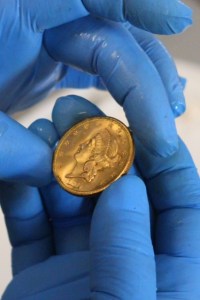
One of the 3,100 recovered gold coins from the SS Central America
This will be the first public display of a portion of the historic gold and silver coins, gold ingots and unopened sacks of treasure gold dust recovered during the 2014 expedition to the Atlantic Ocean site where the Gold Rush-era cargo was lost at sea 161 years ago. The California Gold Marketing Group LLC acquired the never-before-publicly exhibited treasure in a court-approved transaction this past November, and will be publicly displaying the legendary trove for the first time.
“The story of the SS Central America, its cargo, its lost passengers and crew and its survivors is a historic moment in American history, and the recovered items are a time capsule of the great California Gold Rush,” said Dwight Manley, managing partner of the California Gold Marketing Group. “For insurance purposes, we’ve estimated the display’s value at $40 million, but these extraordinary treasures are priceless.”
A 280-foot long, three-masted side-wheel steamship, the SS Central America was carrying tons of California gold that had been shipped from San Francisco to Panama when she sank in a hurricane during a voyage from Aspinwall (now Colón), Panama to New York City in September 1857. The shipwreck site and the gold were discovered more than 7,000 feet below the surface of the Atlantic Ocean in September 1988.
Housed in a 40-foot long re-creation of the famous ship’s hull, the Ship of Gold exhibit originally debuted at the February 2000 Long Beach Expo to display a portion of the vast treasure from the first SS Central America recovery operations in the late 1980s. The exhibit subsequently was seen over the years by millions of people across the United States and overseas.

A few of the 45 gold ingots found on the SS Central America
“The exhibit also includes a type of historic SS Central America items never before displayed: leather satchels filled with more than 1,000 ounces of 1857 California gold dust that were recovered from a safe on the sunken ship!,” exclaimed Manley. The gold dust is contained in the original pokes, hand-sewn sacks that remained sealed since 1857 or earlier.
“This is truly an international discovery. In addition to all the United States coins, the trove includes many coins from around the world, including two Australian gold sovereigns struck in Sydney in 1855 and 1856, and both are the finest known. There also are gold coins from France, including a Napoleon 20 francs, British gold sovereigns of Queen Victoria, Mexican eight escudos, Netherlands ducats, Dutch guldens and Peruvian gold, too,” said Manley.
Robert D. Evans, the chief scientist on the 1980’s mission that first located and recovered a portion of the fabulous sunken treasure and who assisted with the 2014 recovery, will be at the exhibit each day during the show to meet with visitors.
On January 9, 2018, the California Gold Marketing Group received court approval and formally took possession of the treasure recovered from the SS Central America in 2014. It had already been transported from Florida to the Professional Coin Grading Service headquarters in California, but remained in 38 unopened containers that were sealed in June 2014.
Manley and Evans promptly began opening the sealed containers on January 10, and started the careful process of examining, curating and cataloging the trove, one historic piece of treasure at a time.
The three-day Long Beach Expo will be open to the public, Thursday to Saturday, February 22-24, in the Long Beach, California Convention Center, 100 S. Pine Ave.



