BEP: The Monthly Production Report for June 2017 Has Been Posted
 The Monthly Production Report for June 2017 Has Been Posted.
Please click here to access the report.
For a direct link to the PDF report, click here. 

The Monthly Production Report for June 2017 Has Been Posted.
Please click here to access the report.
For a direct link to the PDF report, click here.

Mike Fuljenz with his ICTA medal
The Industry Council for Tangible Assets (www.ICTAonline.org) presented him with the Al Kreuzer Memorial Award medal for “outstanding contributions in the efforts to combat counterfeit coins and currency.”
Fuljenz is a long-time member of the ICTA Board of Directors and a member of their recently-formed Anti-Counterfeiting Task Force. Since the 1980’s he has taught many counterfeit detection and rare coin authentication seminars for collectors, dealers and law enforcement officers.
“I am proud and honored to receive this award, and look forward to additional work with ICTA and other organizations to combat counterfeits and educate the public about the needs to buy and sell rare coins and precious metal bullion coins only with reputable, knowledgeable dealers, such as members of the Professional Numismatists Guild (PNG),” said Fuljenz.
Fuljenz is a member of the PNG’s Accredited Precious Metals Dealer program that requires all members to adhere to a strict code of ethics in the buying and selling of gold, silver and other bullion products. He now has won major awards from the four top organizations in the rare coin hobby and profession: the American Numismatic Association (ANA), Numismatic Literary Guild (NLG), Professional Numismatists Guild (PNG) and the Industry Council for Tangible Assets.
A strong consumer advocate, he received the prestigious PNG Sol Kaplan Award in 2016 in part for assisting an 84-year man recover the $84,000 he had paid to two unscrupulous dealers who sold him counterfeit American Eagle gold coins. Earlier, Fuljenz assisted a group of New Orleans physicians recover $750,000 after they unsuspectingly purchased counterfeit coins from a local attorney.
Summing up the rare coin marketplace during the ANA show in Denver, August 1 – 5, he commented:
“Really nice coins and important coins were in short supply, and highly desired by leading dealers and collectors at the show. These types of coins often brought impressive prices at auctions this week. The United States Mint had long lines of customers wanting to buy their new products. The U.S. Treasury Department exhibits by the United States Mint and the Bureau of Engraving and Printing are always popular and educational.”

2017 NLG Ribbit Award winner David Hall with 2016 winner Mike Fuljenz
As sponsor of the ANA’s top honor, the Farran Zerbe Memorial Award, Fuljenz co-presented it with ANA President Jeff Garrett to Brian Fanton of Iowa. “Brian surprised me at the ceremony by telling me he recalled how much he enjoyed taking one of my ANA coin grading seminars back in the 1980’s,” said Fuljenz.
Known as America’s Gold Expert®, Universal Coin & Bullion President Michael Fuljenz has won more than 60 prestigious national and regional awards and honors for his consumer education and protection work in rare coins and precious metals. His weekly Metals Market Report is available free at www.UniversalCoin.com.

History’s Pawn Stars celebrity Rick Harrison makes the first pass of the electric cutter as NGC Vice President Miles Standish gets his head shaved at the World’s Fair of Money in Denver, Colorado, August 3, 2017, to raise money for the Austin-based Standish Foundation for Child & Family Centered Healthcare and the American Numismatic Association.
(Denver, Colorado) August 3, 2017 – With the help of nationally known television celebrity Rick Harrison and two Denver Broncos cheerleaders, prominent numismatists Michael “Miles” Standish, Jim Halperin and Orlando Rodrigo Lorenzana Williams got their heads shaved at the American Numismatic Association 2017 World’s Fair of Money® in Denver to raise money for two nonprofit organizations. The event on August 3 generated $10,000 in donations that will be evenly divided between the American Numismatic Association (www.money.org) and the Standish Foundation for Child & Family Centered Healthcare (www.sf4c.org).
Immediately after his head was shaved, Standish held up a t-shirt printed with the words: “BALD GUYS Never have a bad hair day.”

Accompanied by Denver Broncos cheerleaders Krista (left) and Brielle (right) the now-hairless Miles Standish holds a t-shirt proclaiming: BALD GUYS Never have a bad hair day.
Standish is an award-winning numismatic author and Senior Grader and Vice-President of Numismatic Guaranty Corporation. Halperin is Co-Chairman of Heritage Auctions and also an author of numismatic books and futurist novels. Williams is Director of Sales at Coin Invest Trust in Liechtenstein.

Professional stylist “Dava” skillfully removed Heritage Auctions Co-Chairman Jim Halperin’s hair at the 2017 Denver World’s Fair of Money to help raise $10,000 for the ANA and the Standish Foundation for Child & Family Centered Healthcare.
Harrison, of the popular History’s Pawn Stars television program and the Las Vegas Gold & Silver Pawn Shop (www.gspawn.com), made the first pass of the electric cutter on Standish’s head and was among those who presented a donation check.
Additional cutting was performed on Standish by coin hobby personalities including Lee Minshull, ANA President Jeff Garrett and former ANA President Ken Bressett.
Broncos cheerleaders Brielle and Krista led cheers, signed autographs and posed for photos during the “Shave Miles” event.
A silent auction of a half dozen plaster sculptures by John Mercanti, who served as the 12th Chief Engraver of the United States Mint, also helped raise funds for the Standish Foundation and the ANA.
Miles’ wife, Andrea Mangione Standish, a certified child life specialist, launched the Austin, Texas-based foundation in 2010. The foundation assists healthcare providers around the world to provide the tools and training they need to minimize healthcare-related pain and suffering in children.
“The mission of the foundation is to have happy, healthy, resilient kids who haven’t been traumatized by healthcare experiences. This event was to help children get better care and to help an important hobby organization dear to me and to so many others, the American Numismatic Association,” he explained.
The 25,000-member American Numismatic Association, based in Colorado Springs, Colorado, is dedicated to educating and encouraging people to study and collect coins and related items. The ANA serves the academic community, collectors, and the general public.
A native of Michigan, Standish began collecting in 1973 at the age of nine. In 2011, he was honored with the “Director’s Coin for Excellence” by then-Director of the United States Mint Edmund Moy.
He is co-author with former Chief Engraving of the United States Mint, John Mercanti, of the 2012 reference book, “American Silver Eagles: A Guide to the U.S. Bullion Coin Program.” Standish’s 2014 book, “Morgan Dollar: America’s Love Affair with a Legendary Coin,” received the 2015 Numismatic Literary Guild award for Best Specialized Book.
Information about the Standish Foundation for Child & Family Centered Healthcare is at www.sf4c.org and information about the American Numismatic Association is at www.money.org.
 DENVER – The United States Mint (Mint) unveiled reverse (tails side) designs for the 2018 coins in its multi-year America the Beautiful Quarters® Program today at the American Numismatics Association’s World’s Fair of Money.
The national sites to be recognized in 2018 are Pictured Rocks National Lakeshore in Michigan, Apostle Islands National Lakeshore in Wisconsin, Voyageurs National Park in Minnesota, Cumberland Island National Seashore in Georgia and Block Island National Wildlife Refuge in Rhode Island.
The design representing Pictured Rocks National Lakeshore depicts Chapel Rock and the white pine tree that grows atop with the inscriptions “PICTURED ROCKS,” “MICHIGAN,” “2018” and “E PLURIBUS UNUM.” This reverse was designed by Artistic Infusion Program (AIP) Designer Paul C. Balan and sculpted by Mint Sculptor-Engraver Michael Gaudioso.
The design representing Apostle Islands National Lakeshore depicts the sea caves at Devils Island with the lighthouse in the background and a kayaker paddling in the foreground. Inscriptions are “APOSTLE ISLANDS,” “WISCONSIN,” “2018” and “E PLURIBUS UNUM.” This reverse was designed by AIP Designer Richard Masters and sculpted by Mint Sculptor-Engraver Renata Gordon.
The design representing Voyageurs National Park depicts a common loon with a rock cliff in the background and the inscriptions “VOYAGEURS,” “MINNESOTA,” “2018” and “E PLURIBUS UNUM.” This reverse was designed by AIP Designer Patricia Lucas-Morris and sculpted by Mint Sculptor-Engraver Joseph Menna.
The design representing Cumberland Island National Seashore depicts a snowy egret perched on a branch on the edge of a salt marsh, ready for flight. Inscriptions are “CUMBERLAND ISLAND,” “GEORGIA,” “2018” and “E PLURIBUS UNUM.” This reverse was designed by AIP Designer Donna Weaver and sculpted by Mint Sculptor-Engraver Don Everhart.
The design selected for the quarter honoring Block Island National Wildlife Refuge depicts a black-crowned night-heron flying over a view from the beach at Cow Cove looking towards Sandy Point. The North Lighthouse is seen in the background. Inscriptions are “BLOCK ISLAND,” “RHODE ISLAND,” “2018” and “E PLURIBUS UNUM.” This reverse was designed by AIP Designer Chris Costello and sculpted by Mint Sculptor-Engraver Phebe Hemphill.
The obverse (heads) of the 2018 quarters will continue to feature the 1932 portrait of George Washington by sculptor John Flanagan. Required obverse inscriptions are “UNITED STATES OF AMERICA,” “LIBERTY,” “IN GOD WE TRUST,” and “QUARTER DOLLAR.”
2018 marks the ninth year of the America the Beautiful Quarters® Program authorized by Public Law 110-456, the America’s Beautiful National Parks Quarter Dollar Coin Act of 2008 (Act). The Act directs the Mint to design, mint, and issue quarter-dollar coins emblematic of a national park or other national site in each state, the District of Columbia, and the five U.S. territories. In accordance with the Act, the Mint is issuing the new quarters at the rate of five per year until 2020 in the order in which each honored site was first established. The final coin will be released in 2021.
 (Denver, Colorado) August 1, 2017 – Officers of the Professional Numismatists Guild (www.PNGdealers.org) have selected Barry Stuppler to be the organization’s President for the 2017 – 2019 term. Stuppler was selected during the PNG Board of Directors meeting in Denver, Colorado on July 30, 2017.
He is President of Stuppler & Company, Inc. in Woodland Hills, California as well as President of the California Coin and Bullion Merchants Association and Chairman of the Gold and Silver Political Action Committee. He also is a former President of the American Numismatic Association (ANA).
“One of the first projects I want to launch during my presidency is to have PNG jointly work with the ANA and the United States Mint to create for April 2018 the largest, most exciting National Coin Week we’ve ever seen. Virtually everyone is interested in ‘money.’ We need to capture the public’s underlying interest and show them the enjoyment of numismatics,” said Stuppler.
Other goals during his presidency will be on-going counterfeit detection and fraud detection educational programs for PNG members, and increasing the benefits of PNG membership. Stuppler also wants to establish professional marketing programs for PNG and the PNG Accredited Precious Metals Dealer program (PNG-APMD).
The other PNG officers selected for the 2017 – 2019 term are: Vice President Richard Weaver of Delaware Valley Rare Coin, Broomall, Pennsylvania; Treasure Wade Milas of RARCOA, Willowbrook, Illinois; and Secretary James A. Simek of Numisgraphic Enterprises, Westchester, Illinois.
In addition to the officers, PNG Board members for the new term are Immediate Past President Dana Samuelson of American Gold Exchange, Austin, Texas and three new Board members: John Brush of David Lawrence Rare Coins, Virginia Beach, Virginia; Brett Charville of Standard Numismatics, Chicago, Illinois; Don Ketterling of D.H. Ketterling Consulting, Reno, Nevada; and Don Rinkor of Rinkor Rare Coins, Santa Rosa, California.
“Under PNG Bylaws, member-dealers of the organization elect the board members at large, and then the elected board members select the officers from within their group. During their July 30, 2017 meeting in Denver, Colorado the nine-member board chose the President, Vice President, Treasurer and Secretary,” explained PNG Executive Director Robert Brueggeman.
Founded in 1955, the Professional Numismatists Guild is a nonprofit organization composed of many of the country’s top rare coin and paper money dealers. A directory of dealers, the PNG Member Code of Ethics and the organization’s Collector’s Bill of Rights can be found at www.PNGdealers.org.
For additional information, contact the PNG by email at info@PNGdealers.org or by phone at 951-587-8300.

Authorized by Congress, the unique 1783 plain obverse Nova Constellatio “Quint” silver coin had a value of 500 units in a proposed but later abandoned early American decimal monetary system that would have ranged from 5 to 1,000 units.
(Photo credit: Image courtesy of PCGS.com)
(Tiburon, California) August 1, 2017 – David McCarthy, senior numismatist at Kagin’s, Inc. of Tiburon, California (www.Kagins.com), has pinpointed the 1783 plain obverse Nova Constellatio Quint pattern (Breen-1102, W-1830) as the first coin officially struck by authority of the United States government, a finding hailed by another U.S. rare coin expert as “one of the most exciting developments in modern numismatics.”
Results of McCarthy’s research on the unique, early American experimental silver coin, that once was in the hands of one of the USA’s Founding Fathers, Alexander Hamilton, are in the August 2017 edition of “The Numismatist,” the official journal of the American Numismatic Association (www.money.org).
Now insured for $5 million, the historic ancestor of the dollar as well as every coin in the western world using a decimal monetary system, will be publicly displayed at the Kagin’s booth, #700, during the ANA 2017 World’s Fair of Money (www.WorldsFairofMoney.com) in Denver, Colorado, August 1- 5.
“It’s a national treasure that was hiding in plain sight until all the pieces of the puzzle recently came together,” said Donald H. Kagin, Ph.D., President of Kagin’s.
“Although the coin was discovered in 1870, it was misattributed. We now have compelling evidence that it is, ‘the first that has been struck as an American coin,’ as described in the April 2, 1783 diary entry of Robert Morris, a signer of the Declaration of Independence and the U.S. government’s first Superintendent of Finance,” explained McCarthy.
“The Quint and a subsequent set of coins were created in Philadelphia in April of 1783 under authority of the Treasury some nine years before the next coins would be struck by the U.S. government. It would have been valued at 500-units in a proposed system that would range from 5 to 1,000 units,” McCarthy said.
“This was the first use of the vital and enduring decimal system to be established in the western world,” stated Kagin.
During the 1770s and 1780s several states and private individuals manufactured coins, but this is the first coin that was struck and paid for by the U.S. government, according to McCarthy’s research, which a dozen other early American coin experts agreed with before he submitted it for publication.
After examining McCarthy’s research, early American coins researcher and writer John Dannreuther of Memphis, Tennessee, the American Numismatic Association’s 2007 Numismatist of the Year, summed up the findings:
“There is a first United States coin, as we have written evidence (in the April 2, 1783 diary entry of Robert Morris, U.S. Superintendent of Finance) that one was delivered:
‘I sent for (metallurgist) Mr. (Benjamin) Dudley who delivered me a Piece of Silver Coin being the first that has been struck as an American Coin.’
“The only coin that logically could be this coin is the Plain Obverse Quint.
“There are numerous things that bring us to this conclusion, the first being that “Nova Constellatio” is not found on the Plain Legend Quint. One does not remove legends, they are added,” explained Dannreuther.
“Secondly, the number of dies noted in the literature can be made to match only by having one die ground down and reengraved. After overlaying the two Quint types, it became obvious that the Plain Obverse die’s eye matched the with Legend eye. Since this is the highest point of the coin, it is the lowest part of the die, as well as the center, it would be logical to leave a small amount of this area as a starting point for the new die. The rest of the die’s detail was removed by the grinding process, of course.”
“Thirdly, the two Quint dies obviously were engraved by two different hands. Since, we know that the with Legend coins match the other denominations in style, as well as having the “Nova Constellatio” legend, the Plain Obverse has to be the first one – thus, it is the first United States coin,” stated Dannreuther.
American Numismatic Association President Jeff Garrett of Lexington, Kentucky also examined McCarthy’s study prior to publication and stated: “David McCarthy’s research makes a compelling case for the 1783 Nova Constellatio Quint being the ‘First American Coin.’ As such, the historical importance of his research, and the coin, is one of the most exciting developments in modern numismatics!”
Only two examples of the 500-unit coin are known, and each is distinctively different on the front. One has the words, NOVA CONSTELLATIO, Latin for “a new constellation,” while the other example does not have any words. The research demonstrates the coin without the words on the obverse was struck first.
After surfacing in New York City nearly 150 years ago, the coin was carefully preserved in several major collections including Lorin G. Parmelee, S.H. and H. Chapman and Wayte Raymond before becoming part of the Garrett Collection and into the possession of Johns Hopkins University where it resided for much of the 20th century. Only now, though, has numismatic research brought together evidence that it was the first federal coin made by authority of the U.S. government.
Kagin’s acquired the coin at an auction in 2013 where it was graded PCGS AU53 Secure. McCarthy began researching it through the writings of Morris and Thomas Jefferson, Continental Congress documents, and forensic evidence found on the coins themselves, and he consulted with other noted experts in early American numismatics.
“While the 1783 Plain Obverse Nova Constellatio Quint is among the most historically significant of all United States coins, it is also one of the most important artifacts in the world,” stated Kagin. “Nothing defines a nation and its society more than its coinage. Just like great documents such as The Magna Carta or The Declaration of Independence established fundamental principles and tenets for western society, so does coinage reflect a nation’s most important ideals, becoming a primary source of communication for a nation’s beliefs.”
“By examining the first coin of the United States and the new decimal monetary system that it ushered in, we gain significant insights to the thinking of America’s Founding Fathers concerning what kind of nation they wished to establish,” he continued.
Kagin said the coin’s inscriptions and symbols contain the most important aspects of our fledging nation:
On the Obverse the central devices are:
The Reverse central inscription includes:
This is followed by the denomination—in this case, 500 units or a Quint. Along with the date, two of the most fundamental and defining issues for Americans then and today are prominently inscribed in Latin so all nations could understand: LIBERTAS (Liberty) and JUSTITIA (Justice).
“This coin, struck in the precious metal silver, was also the very first artifact to present our nation’s new decimal system—in fact, the first use of such a vital and enduring system to be established in the western world,” concluded Kagin.
Kagin and McCarthy made international headlines in 2014 when they assisted an anonymous California couple who discovered the “Saddle Ridge Hoard,” nearly $10 million of 19th century U.S. gold coins buried in rusting tin cans.
 First Day of Sale: August 1, 2017 (8:00 a.m., ET) – The Bureau of Engraving and Printing (BEP) is pleased to introduce Judicial, the third and final card in the 2017 Intaglio Print Program, Constitution Series. This collection features an exquisite compilation of unique, engraved vignettes highlighting the age-old art of intaglio printing in recognition of the U.S. Constitution.
Please visit our website for more product information. CLICK HERE
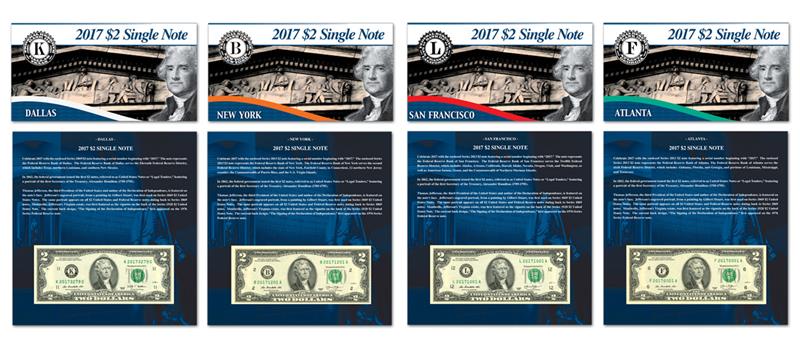 First Day of Sale: August 1, 2017 (8:00 a.m., ET) – The Bureau of Engraving and Printing (BEP) is pleased to introduce the 2017 $2 Single Note Collection, featuring Series 2013 $2 notes from the New York, Atlanta, and San Francisco Federal Reserve Banks and a Series 2009 note from the Dallas Federal Reserve Bank with non-matching serial numbers beginning with 2017. Each note is protected by a clear, acid-free polymer sleeve in an attractive folder representative of the corresponding Federal Reserve District.
Please visit our website for more product information. CLICK HERE
 WASHINGTON – Acting Deputy Director David Motl today announced that Don Everhart, Lead Sculptor at the United States Mint in Philadelphia, will retire at the end of July.
Since joining the Mint in 2004, Everhart has created designs for numerous coins and medals, notably the 2014 National Baseball Hall of Fame Commemorative Coins (selected 2016 Coin of the Year), designing the reverse and sculpting both sides of the first curved coins produced by the U.S. Mint.
He designed and sculpted the common reverse for the Presidential $1 Coin and 14 obverse portraits in the series. His designs appear on three of the 50 State Quarters coins honoring Nevada, New Mexico, and Hawaii and he sculpted three others, celebrating Idaho, Montana, and California. He also sculpted the design of the 2009 quarter that honored the District of Columbia.
Four of the designs in the America the Beautiful Quarters® Program are his, including Hot Springs National Park in Arkansas; Yellowstone National Park in Wyoming; Perry’s Victory and International Peace Memorial in Ohio, and Great Sand Dunes National Park in Colorado.
Other circulating coin designs by Everhart include the 2005 Westward Journey Nickel obverse bearing the profile of Thomas Jefferson and the “Professional Life in Illinois” reverse of the four-coin 2009 Lincoln Bicentennial One-Cent Coin series.
Among the many commemorative designs he has created are the 2016 National Park Service 100th Anniversary gold $5 (both sides) the 2015 March of Dimes Commemorative Silver Dollar reverse (selected the Most Inspirational in the 2017 Coin of the Year awards), the 2010 American Veterans Disabled for Life Silver Dollar reverse; and the 2006 Benjamin Franklin Commemorative Silver Dollar “Founding Father” reverse.
Everhart has also designed many Congressional Gold Medals, including the 2005 Dr. Martin Luther King, Jr., and Coretta Scott King medal obverse; the 2005 Dalai Lama medal obverse, both sides of the 2006 Dr. Michael E. DeBakey medal; both sides of the 2008 Constantino Brumidi medal, and both sides of the 2007 Daw Aung San Suu Kyi medal.
He designed and sculpted the 2014 Shimon Peres medal obverse; the 2015 Jack Nicklaus obverse; the 2014 American Fighter Aces reverse, and 11 of the 2007 and 2008 Code Talkers series of Congressional Gold Medals honoring Native Americans for their military service. In 2016 he designed and sculpted both sides of the Barack Obama Second Term Presidential Medal and the reverse of the First Term medal.
Don began his professional career at The Franklin Mint, where he worked as a sculptor from 1975 to 1980. From 1980 to 2004, he worked as a freelance artist, designing figurines, plates, coins, and medals for Walt Disney, Tiffany, the Royal Norwegian Mint and the British Royal Mint. His work resides in the permanent collections of The Smithsonian Institute, The British museum, and The American Numismatic Society. He is also a Fellow Member of the National Sculpture Society.
 (Pelham, Alabama) — The third edition of MEGA RED (the Deluxe Edition of the Guide Book of United States Coins) features different types of altered coins in several new appendices, including an eight-page illustrated study of love tokens. MEGA RED retails for $49.95 and is available online (including at Whitman.com) and from booksellers nationwide.
A love token is defined as a coin that has been smoothed flat on one or both sides and then hand-engraved, usually with a keepsake message for a sweetheart or family member. Typical messages included terms of endearment, anniversary dates, a lover’s initials, or a romantic symbol such as a heart, blue birds, or flowers.
The MEGA RED appendix is illustrated with photographs of more than 100 love tokens and related items, ranging from tiny half dimes and gold dollars to silver dollars and gold double eagles ($20 coins).
The popular tradition of engraving coins for sentimental or good-luck purposes goes back to Great Britain in the late 1600s. In the United States, the most commonly seen are Liberty Seated dimes (minted from the 1830s to the 1890s). Love tokens saw a resurgence in popularity during World War II, when women on the Home Front would wear “sweetheart jewelry” to honor their loved ones fighting overseas. Many examples were in the form of necklaces or bracelets of foreign coins engraved by soldiers and sailors, with silver coins of Australia being most common.
Because each love token is unique, retail values are difficult to standardize. To aid collectors, the MEGA RED appendix illustrates a catalog of pieces sold at auction in recent years, along with their auction prices. Examples include Liberty Seated and Morgan silver dollars, trade dollars, an Australian sweetheart bracelet, silver quarters and half dollars, foreign and U.S. gold coins, a Barber dime marking the death of President William McKinley, twenty-cent pieces, stick pins made from gold dollars, a so-called opium dollar, and more.
Other appendices in the third-edition MEGA RED discuss special modern gold coins (2009 to date), So-Called Dollars, hobo nickels, chopmarked coins, and modern U.S. Mint gold and silver medals.
Billed as the “biggest, most useful Red Book ever,” MEGA RED measures 7 x 10 inches and has 1,040 more pages than the regular edition. The larger size and increased page count combined make MEGA RED five times bigger than the regular-edition Red Book. It prices 8,200 items in up to 13 grades each, with 48,000 individual values and 15,400 auction records covering circulated, Mint State, and Proof coinage. The book is illustrated with 7,000 images, including 2,434 that are new to the third edition.
The third edition of MEGA RED officially debuted at the Whitman Coin and Collectibles Baltimore Expo, March 30, 2017, and now is available nationwide. MEGA RED retails for $49.95 and is available online (including at Whitman.com) and from booksellers and hobby shops nationwide. Whitman Publishing is the Official Supplier of the ANA, and Association members receive a 10% discount off all purchases.
Whitman Publishing is the world’s leading producer of numismatic reference books, supplies, and products to display and store coins and paper money. The company’s high-quality books educate readers in the rich, colorful history of American and world coinage and currency, and teach how to build great a collection. Archival-quality Whitman folders, albums, cases, and other holders keep collectibles safe and allow them to be shown off to friends and family.
Whitman Publishing is the Official Supplier of the American Numismatic Association. As a benefit of membership in the ANA, members can borrow the Red Book (and other Whitman books) for free from the Association’s library, and also receive 10% off all Whitman purchases. Details are at www.money.org.
 Buy me a coffee
 Recent Blog Posts